
Where to Store AI Agent Data?
No single database model answers every question about agent data. Match each kind to the store built for it, and give durable memory its own layer.


AI agent data is every record an agent reads or writes as it runs. That includes session and working state, conversation history, embeddings, files and artifacts, logs, and long-term memory. No single database model serves all of them. This post covers what each class is, which system fits it, the one rule that keeps the data honest, one source of truth with rebuildable indexes, and where durable memory belongs.
Key takeaways
- No single database model answers every question. Match each class of agent data to the model whose consistency, query, retention, and security fit it, rather than one durable home.
- Keep one source of truth for each type of data. Treat vector, graph, and full-text indexes as copies you can rebuild.
- Memory is a behavior of a system, not a database type. An agent memory system has to decide what to remember, store it, retrieve it, and put it back into context when it's useful.
- Portability is not automatic. Exporting embeddings does not carry your schemas, scopes, provenance, access rules, or deletion policies. Durable memory should live outside any single model, runtime, or app.
In this article
Your agent finishes a run and leaves a a pile of information behind: a conversation transcript, a half-finished plan, tool responses, some embeddings, a few files, and a trace you will want the next time something breaks. These records do different jobs, and forcing them into one storage model creates problems quickly. The harder problem comes later: deciding which data needs to survive beyond the application or runtime that created it.
What kinds of data does an AI agent produce?
An agent produces several distinct classes of data, and each one has a different owner, lifetime, and access pattern.
Session and working state is where a run takes place and what actions can safely happen next: the current plan, completed and pending steps, retry counts, budgets, approvals, locks, and the IDs of side effects. An agent needs to resume from exactly where it stopped without losing or repeating work, so this belongs in a transactional or checkpoint store. LangGraph's server writes checkpoints after each step and resumes an interrupted run from the last one.
Conversation and event history is the ordered record of messages, tool requests, responses, and timestamps. Keep a raw audit record separate from any compressed summary, so the summary can be regenerated and challenged. Replaying full history is not selective memory, and it grows without bound.
Long-term memory is a smaller set of records meant to influence later runs: preferences, confirmed facts, prior outcomes, and reusable lessons. Each has a scope, source, timestamp, and expiration. This class exists because a base model does not carry state between runs, which is why agents lose memory between sessions.
Embeddings and retrieval records are the vectors plus the metadata that makes them usable: source record ID, chunk offsets, content hash, tenant and ACL fields, and the embedding model and version. You need this metadata because changing the embedding model or dimension usually means re-embedding and reindexing.
Files and artifacts are the bytes: patches, reports, PDFs, datasets, and model-generated deliverables. If you store the bytes in object storage, you can keep the lineage, hash, owner, status, and URI in your operational database.
Logs, traces, and evaluation data are the retrieved candidates, assembled context, outcome labels, cost, and latency. Without the candidate set and the final context, you cannot tell whether a failure came from generation, retrieval, filtering, or stale storage.
One more rule worth stating plainly: secrets are generally not memory. Store credential references in a secrets manager, grant short-lived scoped identities, and record only which authorization was used.
What's different about storing data for autonomous agents?
Autonomous agents need more than chat history, because their work spans many steps and can fail after it has already changed something in production.
Resumability. A chatbot can retry a turn. An agent may have edited files, sent requests, or spent money before a crash. Store step-level checkpoints and idempotency keys so it can resume without repeating those actions.
Shared state and concurrency. When multiple agents work on the same task, they need clear rules for who can change what and how conflicts are resolved. A vector search can't tell you which agent owns a task. LangGraph keeps durable state in PostgreSQL and uses Redis for signaling, which shows the split between coordination and durable truth.
Action provenance. The more an agent can do, the more dangerous bad memory becomes. If an agent uses stored information to send money, change a file, or call an API, you need to know where that information came from, when it was valid, and whether the agent was allowed to use it. Before an irreversible action, the agent should re-check the current system of record. Poisoning is a real path: AgentPoison, a peer-reviewed NeurIPS 2024 study, corrupted under 0.1% of memory records yet reached at least 80% average attack success across three agent types, with no change to model weights.
Multi-tenant blast radius. If your system serves multiple users or organizations, enforce tenant and access rules before data reaches the model. Don't rely on the LLM to decide what a user is allowed to retrieve. MongoDB's own vector-search guide notes that a tenant pre-filter constrains results but is not the same as database-level isolation. For how this state accumulates and gets recalled, see how AI agents learn from past interactions.
The rule that prevents most mistakes: source of truth versus derived indexes
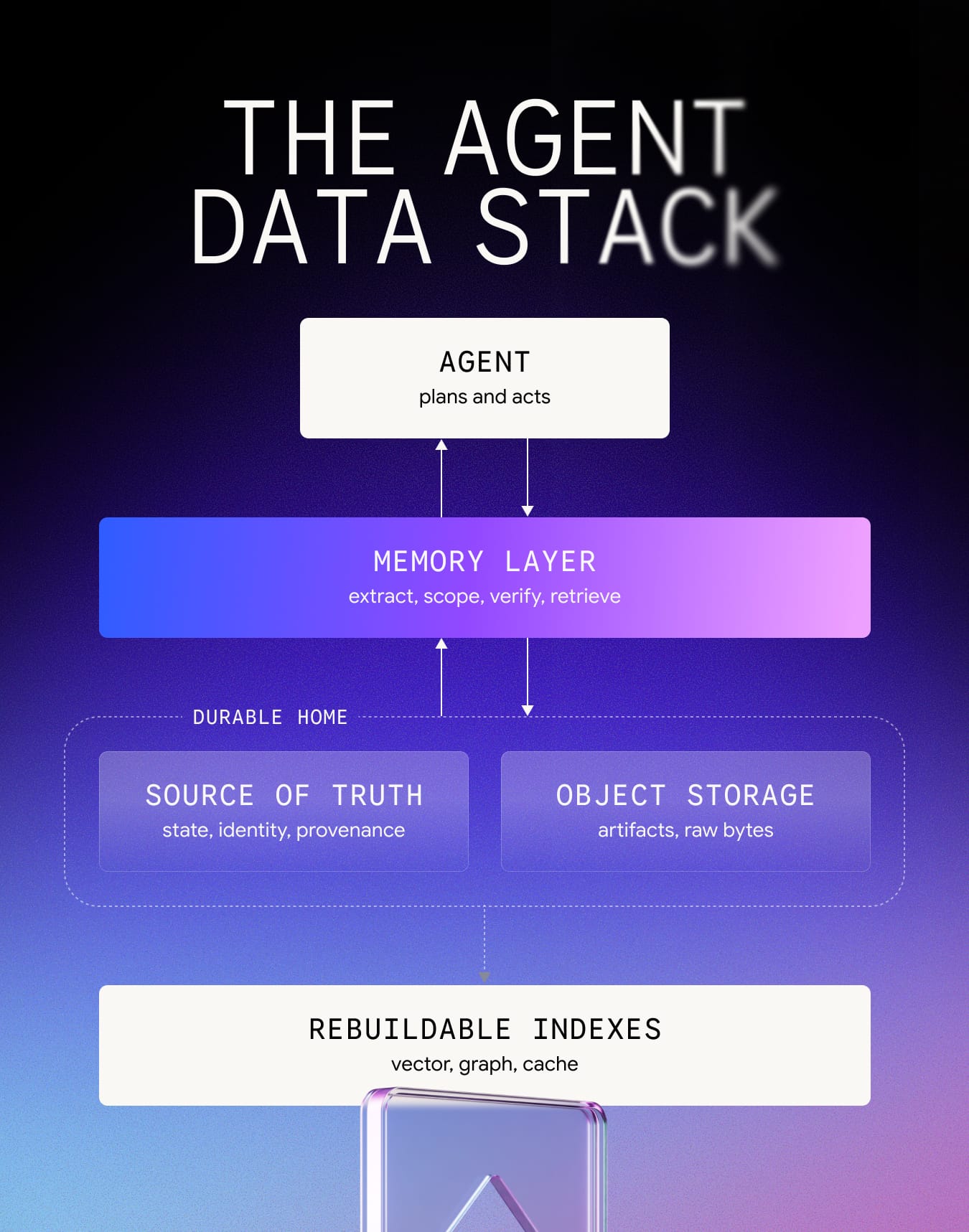
Keep one authoritative source of truth, and treat every search index as a rebuildable projection of it. This is the single decision that keeps an agent's data honest as it grows.
The source of truth is the record you cannot regenerate: the transactional state, the confirmed facts, the raw events, the artifact bytes. A derived index, a vector index, a graph, a full-text index, are things you build from that source to answer a particular kind of question, and are data artifacts you can throw away and rebuild.
A vector index is the clearest example. It depends on your embedding model, chunking strategy, and distance metric. Change those, and you may need a new index. That's routine if the original data still exists somewhere else. It's a serious problem if the vector index quietly became your only copy of information the agent depends on.
When you keep this line clear, migrations, model swaps, and index changes stay safe, because the truth never lived in the thing you are rebuilding. When you blur it, a re-embedding job or a compaction pass can silently drop a fact, and you have no source to restore it from.
This is also where consolidation pays off. Different query models are not the same as different providers, and you do not need a separate vendor for every class of data. What you want underneath is one durable home for the records that must persist, with the specialized indexes projecting from it. That is the role Walrus is built for as a Verifiable Data Platform: a foundation to store and manage your data, persistent, portable, and under your control across apps, providers, and agents. Your transactional and vector layers still sit where they belong; the authoritative data underneath has one verifiable home.
What are your storage options, and what is each for?
There are five storage categories, each good at one job and poor at others. Memory layers sit on top of these.
Relational and document databases (PostgreSQL, Aurora, MongoDB, SQLite for prototypes) are the natural home for authoritative structured state: joins, transactions, row versions, provenance, and checkpoints. LangGraph Agent Server, for example, uses PostgreSQL by default for persistent application data such as threads, runs, checkpoints, and stored items. They are not the fastest at very large approximate-nearest-neighbor workloads.
Key-value and cache stores (Redis, DynamoDB) are for hot session state, counters, locks, deduplication keys, and TTL-bound values. They're useful when data needs to be read or updated quickly, but temporary state is the wrong place for evidence that needs to survive an audit.
Vector databases (Pinecone, Qdrant, Weaviate, Milvus, pgvector, and others) are for semantic similarity and filtered retrieval. Use them to find relevant information by meaning. Don't make the vector index your only copy of important data or rely on it alone to enforce access.
Object and blob storage (Amazon S3, Google Cloud Storage, Azure Blob, MinIO) are for large immutable outputs, raw logs, media, backups, and content-addressed artifacts. Object storage is good at keeping large files cheaply and reliably. It doesn't manage your agent's workflow or understand what a file means, so you'll usually pair it with a database or search index.
Walrus sits in this category with a difference: it is a Verifiable Data Platform, a durable home for your data that is provider-independent and verifiable, so you can confirm stored bytes have not been tampered with since upload and move them across providers instead of locking to one.
Graph databases (Neo4j, Neptune, ArangoDB) are for explicit entities, dependency paths, temporal relationships, and multi-hop provenance. Extraction is costly, and generated edges can be wrong. Graph tooling also inherits injection risk: a March 2026 advisory for Graphiti documented attacker-controlled labels reaching Cypher construction through prompt injection.
How do you choose where each kind of data goes?
Start with what the data does. Is it state the agent needs to resume work? A file that has to persist? An index for semantic search? A relationship graph? Temporary coordination data? Or memory that needs to influence future runs? Then choose the system built for that job. Keep the original data separate from the indexes you can rebuild, decide what must survive a crash, and enforce tenant and access rules before data reaches the model. The table maps the classes to their fit.
Where does durable memory belong?
Memory is a behavior of the surrounding system: a write policy that decides what is worth keeping, storage that persists it, retrieval that finds it, and context assembly that puts it in front of the model at the right moment. A vector index can serve the retrieval step, but on its own it does not decide what to remember, resolve conflicting facts, scope a record to a user or project, expire what is stale, or establish that a recalled item is true.
Agent memory layers do that job. LangGraph's checkpointer and store, Mem0, and others sit above raw storage and decide what to extract, consolidate, scope, expire, and retrieve. Their backend may be SQL, vector, graph, or a combination, and they are typically tied to the framework or service that provides them. None of them remove the need for a source of truth, artifact storage, and access control underneath.
Durable memory belongs in a persistent layer that lives outside any single model, runtime, or app. Note the scope: memory is one class of agent data, not all of it. Your transactional state, artifact bytes, and embeddings still live in the systems above. What memory needs on top of raw storage is a write policy, scoping, provenance, and rules for how memories are corrected, retained, or deleted. There is no universal cross-provider standard that makes all of this portable today.
Walrus Memory is a portable memory layer for AI agents, the memory layer built on the Walrus Verifiable Data Platform. It keeps durable memory outside the model or tool that created it, so connected tools can access the same memory across sessions and workflows. You define who can access it, and its integrity can be independently verified. Memory stops being tied to one runtime and can move with your agent across tools.
FAQs
Is a vector database enough for agent memory?
No. A vector database helps you find information by semantic similarity. An agent memory system also needs to decide what gets remembered, how memories are scoped and retained, and when they should return to the model's context. Your exact task state and artifacts also live elsewhere.
Can I just use object storage like S3 for agent data?
Use it for the right data. Object storage is well suited to files, large outputs, raw logs, media, and backups. But storing a file doesn't give your agent transactions, workflow state, or semantic retrieval. You'll usually pair object storage with a database, index, or catalog depending on how the data needs to be used.
Where does autonomous agent state live?
In a transactional or checkpoint store that supports exact recovery. Autonomous runs edit files, call APIs, and spend money, so you need step-level checkpoints and idempotency keys to resume without repeating actions that already happened. LangGraph writes checkpoints after steps and keeps that durable state in PostgreSQL while using Redis only for ephemeral coordination.
Is Walrus Memory a vector database?
No. Walrus Memory is a portable memory layer for AI agents. A vector database is one way to index data for semantic retrieval. Walrus Memory handles the memory layer, including persistent memory and scoped access, so the same memory can remain available across sessions, apps, and workflows.
How portable is agent memory between providers today?
There is no universal standard that makes agent memory portable across providers today. Exporting embeddings alone does not carry your schemas, scopes, access rules, metadata, provenance, or retention policies. Keeping memory outside any single model or runtime is one way to remove that dependency. Walrus Memory is designed around that model: persistent memory that can be accessed across supported tools and workflows instead of remaining bound to the assistant that created it.
About Walrus
Walrus is a Verifiable Data Platform for builders in AI and onchain finance. No more fragile foundations: Walrus finally makes it possible to verify where data came from, prove it hasn't been tampered with, and know it's always available, without compromising on speed. It is the foundation for applications where unverifiable data can cause irrecoverable losses. The more we trust AI and onchain finance with our money and decisions, the more mission-critical this becomes. Created by the ex-Meta engineers behind Sui.